AI-Assisted Maintenance – What Changes, Everything?

Industrial maintenance is undergoing a major transformation. The boundaries between production and maintenance are blurring, data-driven decision-making is increasing, and workforce competency structures are changing rapidly. At the same time, artificial intelligence and machine learning are introducing new ways to improve equipment availability, industrial safety, and knowledge transfer across generations. But what does this actually mean for day-to-day operations?
In recent years, the traditional barriers between production and maintenance have largely disappeared - or at least are disappearing fast. With leaner teams and more flexible roles, organizations are trying to achieve more with fewer resources. Beyond automated condition monitoring, both maintenance and production personnel now actively contribute to capturing asset‑related information.
The development of daily management systems has focused on efficient data collection and clear visualization of reporting. Mobile devices are here to stay and are tremendously helpful in eliminating delays in data collection and executing tasks. At the maintenance site, information enriched with images and videos is immediately classified as structured data, which can be used to effectively manage and develop operations.
Then AI entered the market, and with it, maintenance can take a remarkable leap forward. While using AI to tackle industrial maintenance and operational challenges we often encounter with these megatrends:
- The arrival of AI in workplaces is itself one such trend.
- In developed countries, shrinking younger generations are not interested in industrial jobs labeled as old-fashioned.
- A looming retirement wave in the industry.
- The high risk of losing tacit knowledge as experienced professionals exit the workforce.
- Generational differences in how employees work and adopt digital tools.
- Industrial safety is a priority.
Common maintenance challenges include tasks not being completed on time, difficult scheduling, gaps in task‑specific competencies, and difficulty finding necessary documents. In rush situations, things are not always done safely, or they are done incorrectly first.
Management, on the other hand, struggles with not having a clear, real‑time overview of task progress. Shutdown scheduling and resource planning are complex and often based on rough estimates. Onboarding new employees takes considerable time and burdens shift management and more experienced personnel.
AI to support daily operations
AI‑assisted solutions directly address these challenges directly. At the core are ABB’s Industrial Knowledge Vault (IKV) and Connected Worker (CW), an industrial knowledge application and mobile‑supported platform for creating, accessing, and managing task‑critical information.
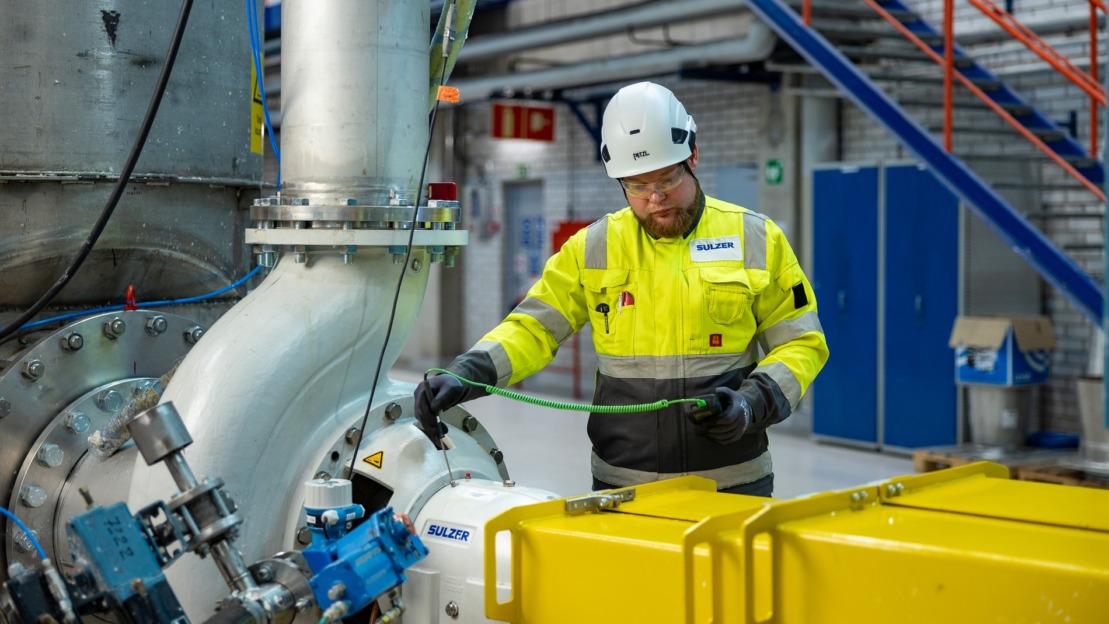
With a mobile device or HoloLens, employees receive necessary information directly at the work site, significantly accelerating task execution. A single photo – or better yet, a short video – often communicates far more than text alone. Users interact with the system's AI prompt by asking plain-language questions and receiving clear, task-specific recommendations based on mill’s documentation and data. When available, the instructions include images or videos.
In the background, the system has access to mill’s documentation, system supplier manuals, maintenance instructions, and measured process data. It also incorporates workflow logs, recorded support calls, and user feedback. Data is continuously collected to enrich the knowledge base, with robust cybersecurity safeguards protecting all information.
With clear, step-by-step workflows, even less experienced workers can perform tasks efficiently and safely, getting it right the first time. Managers, in turn, can quickly onboard new employees. The system also captures tacit knowledge and safeguards critical operational knowledge.
Management gains a continuous visual overview of all tasks, whether it's a regular scheduled task or a sudden repair or maintenance action. The system also tracks the time spent executing workflows and supports the identification and sharing of best practices.
Closing the loop
This combination of AI, mill’s knowledge base, and mobile tools streamlines workflow management for both routine inspection rounds and troubleshooting. There is also tremendous potential in optimizing shutdown planning, as the system learns how long tasks actually take and what resources are needed.
Asset Performance Management (APM) solutions are widely adopted across the industry. ABB Ability™ Asset History Twin is an example of an advanced condition monitoring system that tracks equipment health and performance while identifying emerging anomalies. By leveraging measured data, maintenance teams can plan interventions at the right time and with the right scope, ensuring that service and repair activities have minimal impact on production.
AI and machine learning algorithms have also been introduced to maintenance systems to find anomalies and subtle changes from massive data volumes. Modern APM classifies all alarms and warnings by potential impact, giving users a clear visual prioritization of the order in which issues should be addressed, whether at the site level or within departments.
The aim of combining these solutions is to minimize unplanned downtime due to sudden equipment failure:
- APM provides equipment insights and visually classifies alarms by criticality.
- Industrial Knowledge Vault creates and manages clear workflows and instructions.
- Connected Worker mobile solution helps users operate efficiently by bringing instructions directly to the work site.
Critical alarms often need to be resolved under pressure. In such cases, immediate access to clear instructions based on OEM’s documentation and mill’s applications are invaluable for efficient and safe execution, especially for new employees. Even experienced workers encounter situations where new equipment fails for the first time.
The results speak for themselves
Industrial Knowledge Vault has delivered highly encouraging, and in many cases, transformative, results:
- Time savings: 85% less time required to create workflows
- Quality improvement: 90% reduction in human errors
- Simplified supervision: 45% increase in team productivity
What actually changes?
With AI-assisted solutions, knowledge related to mill systems, processes, and operations is more readily available to employees as they perform their tasks. This reduces skill gaps and improves the performance of less experienced workers.
Managers have better situational awareness. Shutdown planning becomes easier when resource scheduling is more visual and based on measured data. At any given moment, it is clear what tasks are being performed and what stage of completion they are at.
Capturing expert knowledge becomes significantly easier thanks to collecting comments of workflows, stored best practices and active monitoring of task execution.
Motivational factors are often harder to measure, but their impact is visible in practice. When employees no longer need to search for instructions in a jungle of folders or manuals, work becomes more efficient and success experiences increase. Clear and safe instructions reduce uncertainty, supporting both learning and high‑quality performance. Motivated employees are also more attentive and better able to absorb new knowledge.

About the author
Risto Vuopala is a Senior Sales Manager at ABB, Process Industries division, focusing on digital solutions for industrial applications. He brings extensive experience in production, energy, and maintenance automation and digital solutions, with a career spanning from the early 1990s to the present.